Chapter 29: Reading price history charts
Why history matters
Today's price and rank are a single moment. A product's history shows you what normally happens: how often it sells, what price it usually sells at, who else sells it, and whether this time of year is typical. It's the best protection against buying at a temporary price spike.
Every ArbiSource result has a history graph under the profit calculator. Choose 30 DAYS, 90 DAYS, 180 DAYS or 365 DAYS, click the graph to enlarge it, and click a line's name to show or hide it.
The lines on the graph
| Line | What it shows | What to look for |
|---|---|---|
| Sales rank (BSR) | The product's rank over time | Frequent drops (downward spikes) mean regular sales |
| Amazon price | When Amazon itself sells the product, and at what price | Whether Amazon is on the listing, and how often it's in stock |
| Buy Box price | The price of the offer most customers buy from | The price you'll realistically sell at |
| Lowest FBA price | The cheapest offer fulfilled by Amazon | Your direct competition |
| Lowest FBM price | The cheapest offer sent by the seller rather than Amazon (FBM, Fulfilled by Merchant) | Usually less competitive with Prime customers, but worth noticing |
Start by showing just the sales rank, Buy Box price and Amazon price, then add the others. To see how the number of sellers has changed, hover over the magnifying glass next to Total Sellers (Chapter 30).
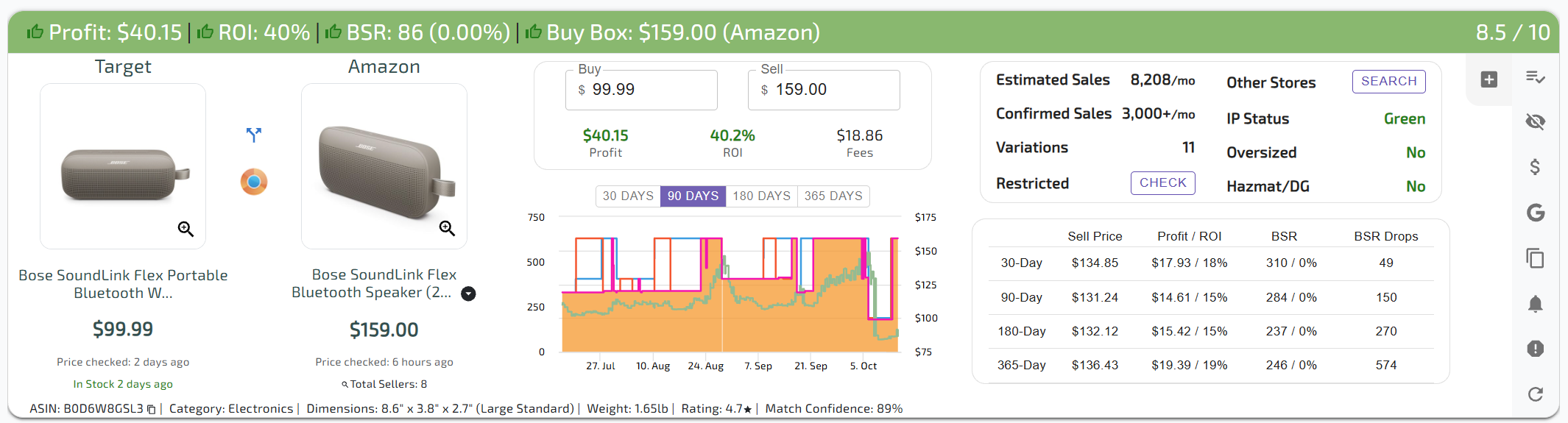
ArbiSource's own graph is all you need for this. If you'd like even longer or more detailed histories, Keepa is an optional extra, and the same lines and patterns apply there.
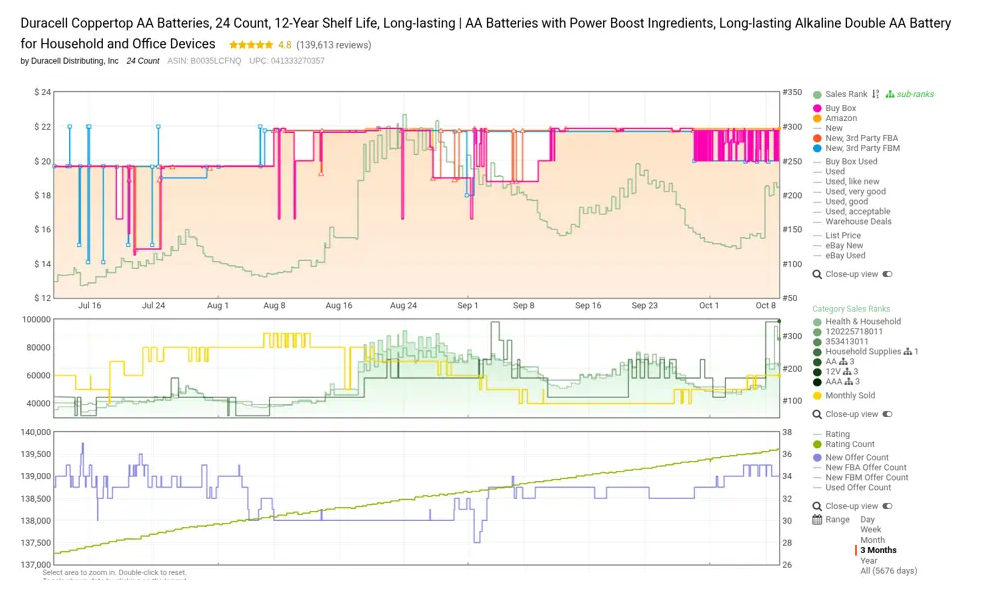
Reading sales from the rank line
Each time the rank line drops sharply, a sale has most likely happened.
- Lots of drops, evenly spread: steady demand.
- Drops bunched together, then nothing: sales came in a burst, perhaps during a promotion or a busy season.
- A flat or rising line for weeks: very few sales.
ArbiSource counts these drops for you. The number of BSR drops for 30, 90, 180 and 365 days is in each result panel (Chapter 28).
Four patterns worth recognizing
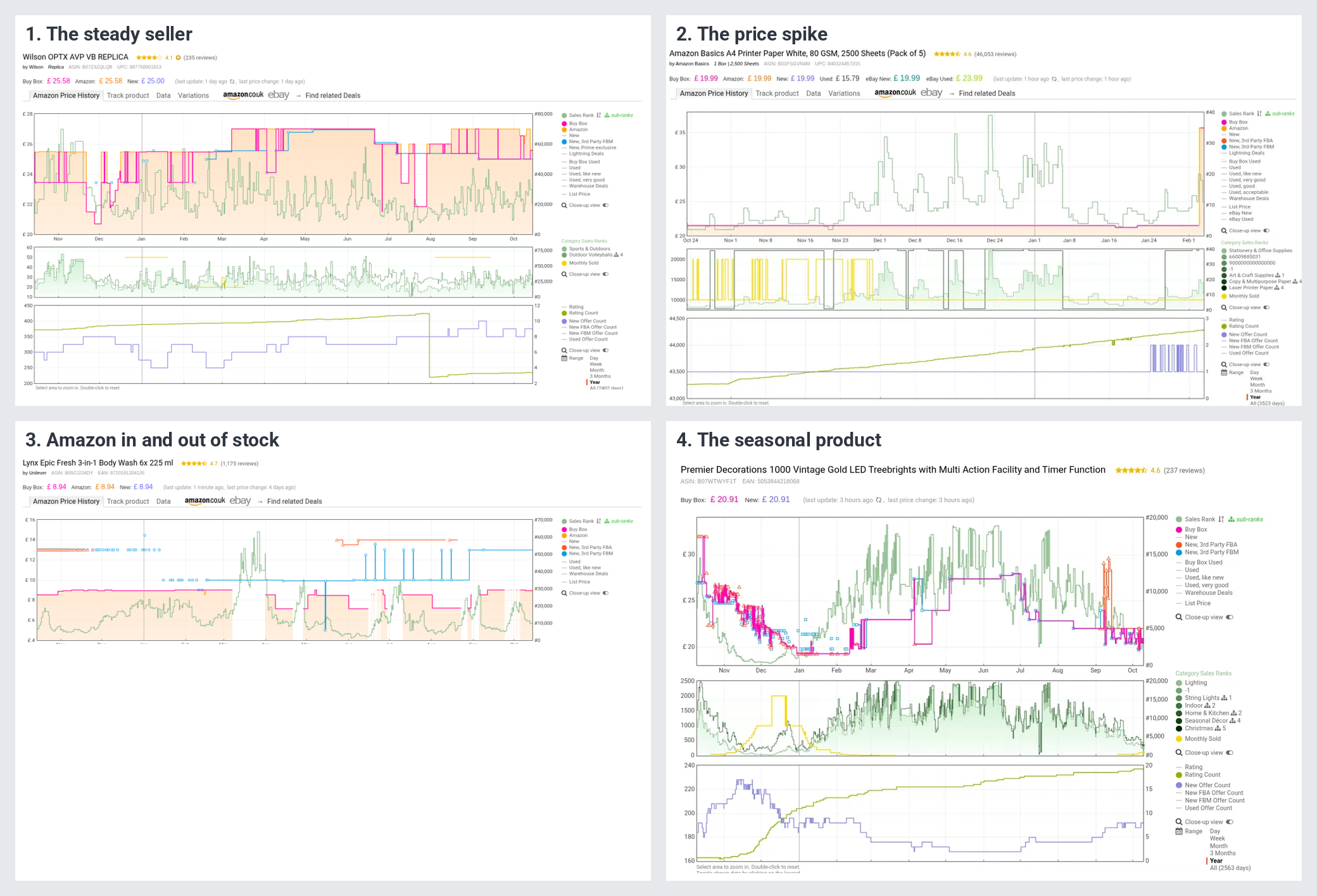
1. The steady seller. Regular rank drops and a Buy Box price that moves within a narrow band. These are the products to build a business on, even if the profit per unit is modest.
2. The price spike. The Buy Box price jumps well above its usual level, often because stock ran low or Amazon went out of stock. When the spike is at the right-hand end of the chart, as in the example below, today's price is the spike. A lead that's only profitable at the spike price will probably sell at the normal price by the time your stock arrives. Check the profit at the average price (Chapter 27), and use the average-profit filter to screen spikes out.
3. Amazon in and out of stock. The Amazon price line appears and disappears. When Amazon is in stock, it often takes most of the sales at a lower price. When it runs out, other sellers' prices rise. If Amazon is usually in stock, be cautious. If it's often out of stock for long periods, there can be a real opportunity, but price your plans on the times Amazon is in stock.
4. The seasonal product. Rank and price improve at the same time each year: before Christmas, in summer, or around a specific event. Use 365 DAYS to look back a full year. Buying a seasonal product just as its season ends can leave you holding stock for months.
If a lead looks steady on sales, price, Amazon's presence, competition and season, it passes the Momentum question in the Lead Check.