Chapter 26: Prep and labeling
What you'll learn: how to label every unit with an FNSKU, the packing rules you'll use most often, US box limits, and a simple starter kit so your first shipment arrives ready to sell.
Prep is your responsibility, or a prep center's if you pay one. The rules below are the ones US sellers use every day: an FNSKU on each unit, the right bagging where needed, and boxes within Amazon's US size and weight limits.
Label every unit
Amazon identifies your stock by an FNSKU barcode on each unit. Without it, the unit can't be received against your account.
- Print the labels from Seller Central when you create your shipment (Chapter 27), or from the product's inventory page. Each label shows a scannable barcode, the FNSKU, a short product title and the condition (for example, "New").
- Put one label on every unit, on a flat part of the packaging, not on a corner or curve.
- Cover the manufacturer's barcode (the UPC or EAN) so Amazon's scanners read your FNSKU, not the original code. Opaque tape or a label that covers it completely both work. Leave any Transparency code or serial-number barcode uncovered (Chapter 23).
- Keep the barcode scannable after any poly bagging or bubble wrap: either put the FNSKU on the outside, or make sure it reads through a clear bag.
- One FNSKU per unique product: different sizes, colors or conditions each need their own FNSKU.
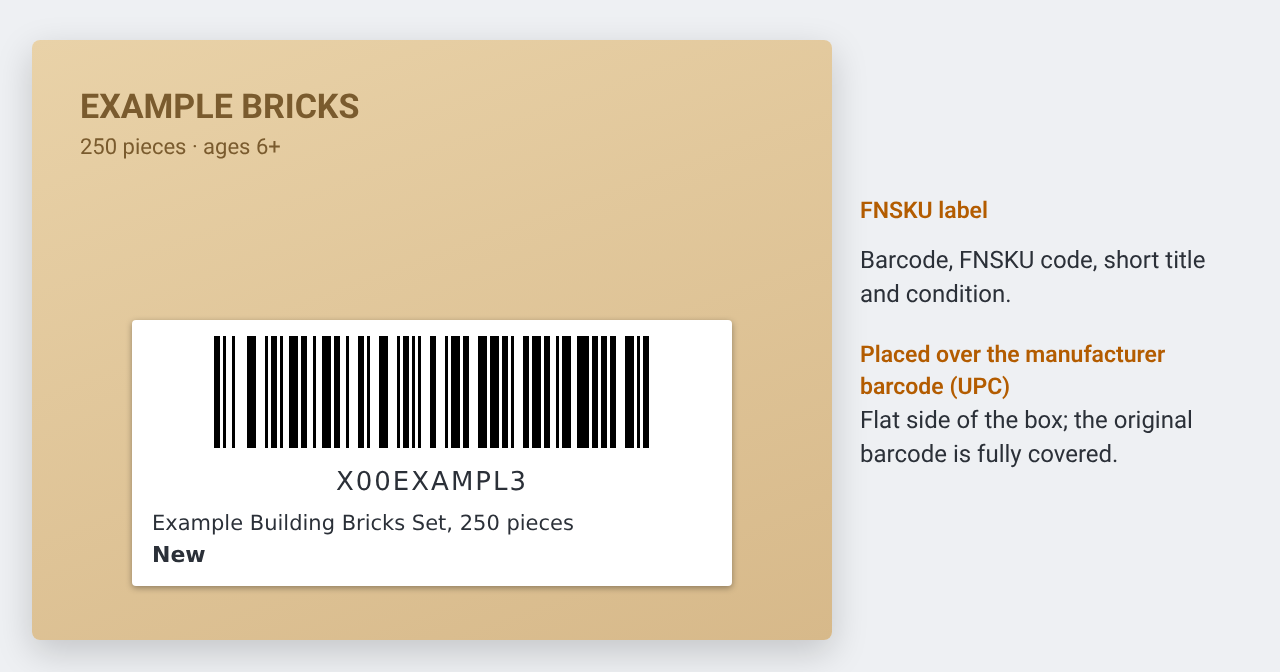
An FNSKU label: Code 128 barcode, FNSKU, short product title and condition (New), on a plain box. Simplified illustration – the real screen may look different.
"Prep and labeling (US)": printing FNSKUs, covering the UPC, poly bagging a unit and packing a box within the US size and weight limits.
Pack the unit
Poly bags. Bag a unit when it needs protection, when the packaging could open in the fulfillment center, or when the prep guidance for that ASIN asks for a bag.
- At least 1.5 mil thick, transparent and completely sealed.
- The bag shouldn't extend more than 3 inches past the product. Tape down loose edges if needed.
- The FNSKU must scan on or through the bag.
- If the opening is 5 inches or more (measured flat), the bag needs a suffocation warning, printed on it or added as a label, for example: "Warning: To avoid danger of suffocation, keep this plastic bag away from babies and children. Do not use in cribs, beds, carriages or playpens. This bag is not a toy."
Bubble wrap. Use it for glass, ceramic and other fragile items so the product can't move inside the wrap. Seal it with tape, and put the FNSKU on the outside.
Sold as a set. If several items sell together under one ASIN, seal them so they can't be separated and add a clear label such as "Sold as set" or "This is a set. Do not separate." Cover the barcodes on the individual items inside so only the set's barcode is scanned.
Expiration-dated products. Follow the date format and shelf-life rules in Chapter 24: the date on each unit and on the outer pack, and one expiration date per ASIN in each box.
Read Amazon's full guide: Packaging and prep requirements.
Pack the box (US limits)
Amazon applies these limits to boxes shipped to US fulfillment centers:
| Rule | Limit |
|---|---|
| Maximum size | 36 × 25 × 25 in (length up to 36 in; width and height no more than 25 in) |
| Maximum weight | 50 lb per box |
| Single oversize item | The only exception: a box holding one item that's longer than 36 in or heavier than 50 lb, sized closely to that item |
| Over 50 lb (single item) | "Team Lift" labels on the top and sides of the box |
| Over 100 lb (single item) | "Mechanical Lift" labels on the top and sides |
| Jewelry and watches | No more than 40 lb per box |
| Recommended minimum | At least 6 × 4 × 1 in and 1 lb, which helps avoid delays |
Also:
- Use a sturdy, six-sided cardboard box with the flaps intact, and leave about 2 inches of cushioning between items and the sides of the box (not needed for an unopened manufacturer case pack).
- One shipment ID per box: don't mix products from different shipments in the same box.
- If you reuse boxes, remove or cover old shipping labels and barcodes, other than the Amazon box ID label you'll add in Chapter 27.
- Give Amazon accurate box weights and dimensions when you create the shipment.
Source: Shipping and routing requirements.
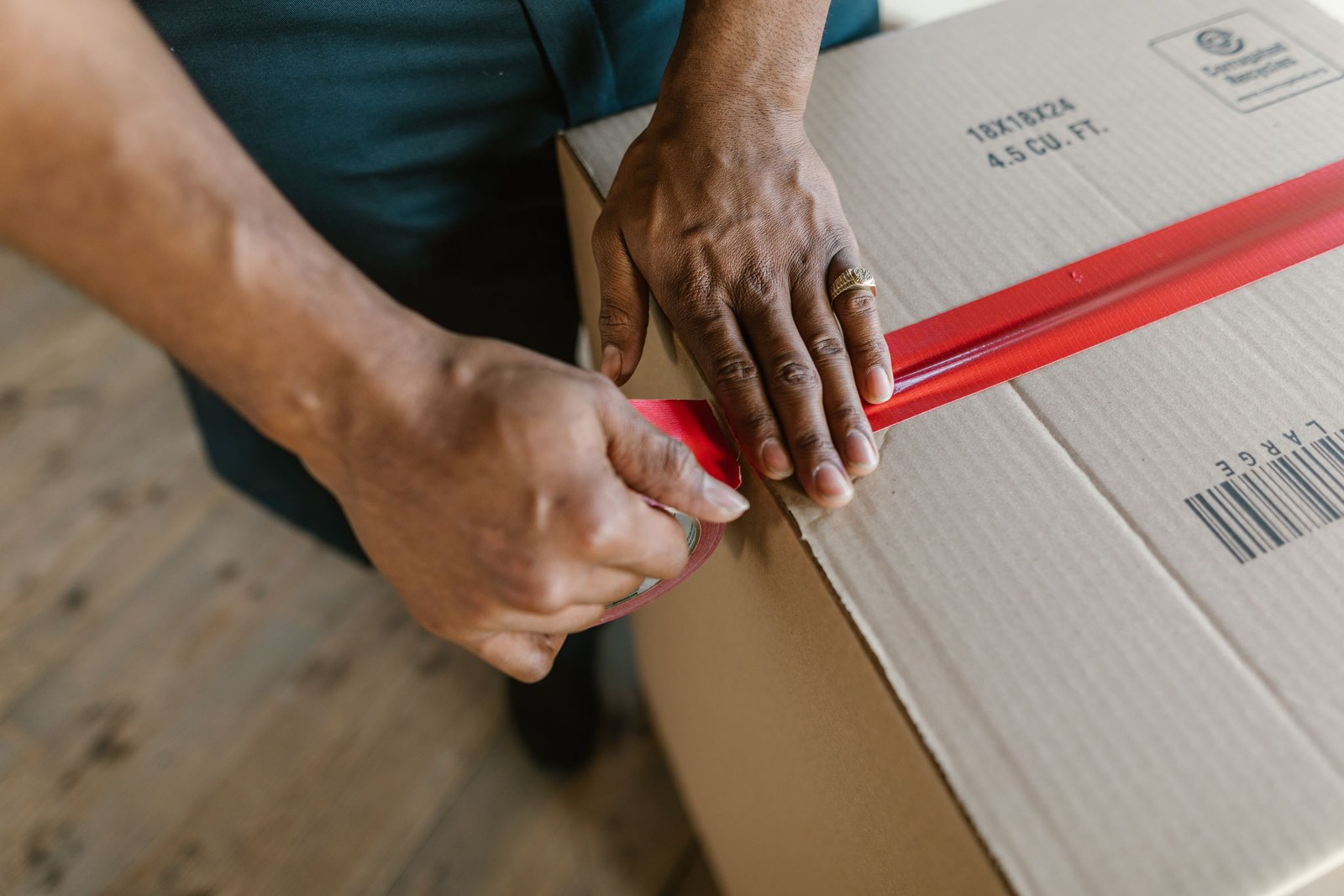
Sealing a packed box with tape. Photo: RDNE Stock project / Pexels.
What to have on hand
A small home setup is enough to begin:
- A thermal label printer and labels for FNSKUs and box labels (4 × 6 in is the common size for box labels; product labels are smaller)
- Clear poly bags in a few sizes, with suffocation-warning labels
- Bubble wrap, strong packing tape and a tape gun
- A shipping scale that weighs past 50 lb, and a tape measure
- Sturdy cardboard boxes within the limits above
- A marker for covering stray barcodes on outer boxes
As you grow, a prep center can label, bag and box for you for a per-unit fee, and many can ship straight to Amazon for you. Many sellers start at home and hand over some or all of the work later. A prep center's fee is a cost per unit, so add it to your numbers (Chapter 7).
Checklist
- Every unit has an FNSKU label covering the manufacturer barcode
- Transparency codes (if any) are left uncovered
- Poly bags are 1.5 mil or thicker, sealed, scannable and carry a suffocation warning when needed
- Sets are sealed and labeled "Sold as set"
- Each box is within 36 × 25 × 25 in and 50 lb