Chapter 35: Prep and labeling
Prep is your responsibility, or a prep center's if you pay one.
Label every unit
Amazon identifies your stock by an FNSKU barcode on each unit. Without it, the unit can't be received against your account.
- Print the labels from Seller Central when you create your shipment (Chapter 36), or from the product's inventory page.
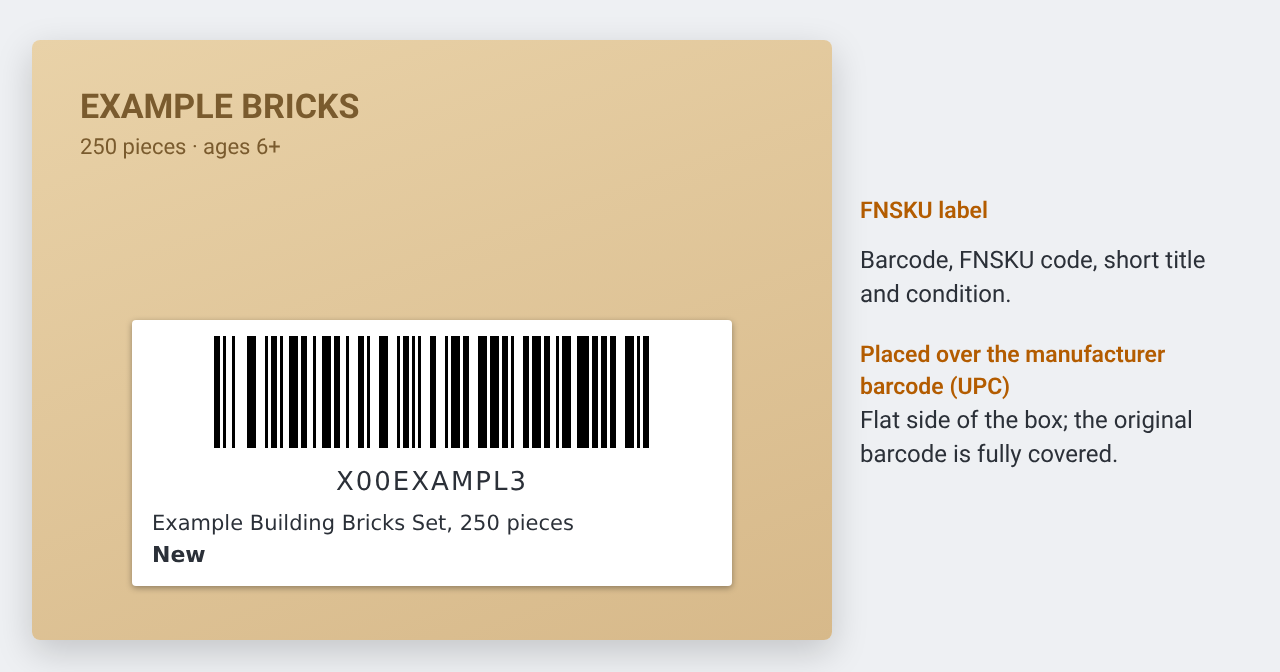
- Put one label on every unit, on a flat part of the packaging, not on a corner or curve.
- Cover the manufacturer's barcode (the UPC or EAN) so Amazon's scanners read your FNSKU, not the original code. Opaque tape or a label that covers it completely both work. Leave any Transparency code or serial-number barcode uncovered (Chapter 32).
- Keep the barcode scannable after any poly bagging or bubble wrap: either put the FNSKU on the outside, or make sure it reads through a clear bag.
- One FNSKU per unique product: different sizes, colors or conditions each need their own FNSKU.
Pack the unit
Poly bags. Bag a unit when it needs protection, when the packaging could open in the fulfillment center, or when the prep guidance for that ASIN asks for a bag.
- At least 1.5 mil thick, transparent and completely sealed.
- The bag shouldn't extend more than 3 inches past the product. Tape down loose edges if needed.
- The FNSKU must scan on or through the bag.
- If the opening is 5 inches or more (measured flat), the bag needs a suffocation warning, printed on it or added as a label, for example: "Warning: To avoid danger of suffocation, keep this plastic bag away from babies and children. Do not use in cribs, beds, carriages or playpens. This bag is not a toy."
Bubble wrap. Use it for glass, ceramic and other fragile items so the product can't move inside the wrap. Seal it with tape, and put the FNSKU on the outside.
Sold as a set. If several items sell together under one ASIN, seal them so they can't be separated and add a clear label such as "Sold as set" or "This is a set. Do not separate." Cover the barcodes on the individual items inside so only the set's barcode is scanned.
Expiration-dated products. Follow the date format and shelf-life rules in Chapter 33: the date on each unit and on the outer pack, and one expiration date per ASIN in each box.
Read Amazon's full guide: Packaging and prep requirements.
Pack the box (US limits)
Amazon applies these limits to boxes shipped to US fulfillment centers:
| Rule | Limit |
|---|---|
| Maximum size | 36 × 25 × 25 in (length up to 36 in; width and height no more than 25 in) |
| Maximum weight | 50 lb per box |
| Single oversize item | The only exception: a box holding one item that's longer than 36 in or heavier than 50 lb, sized closely to that item |
| Over 50 lb (single item) | "Team Lift" labels on the top and sides of the box |
| Over 100 lb (single item) | "Mechanical Lift" labels on the top and sides |
| Jewelry and watches | No more than 40 lb per box |
| Recommended minimum | At least 6 × 4 × 1 in and 1 lb, which helps avoid delays |
Also:
- Use a sturdy, six-sided cardboard box with the flaps intact, and leave about 2 inches of cushioning between items and the sides of the box (not needed for an unopened manufacturer case pack).
- One shipment ID per box: don't mix products from different shipments in the same box.
- If you reuse boxes, remove or cover old shipping labels and barcodes, other than the Amazon box ID label you'll add in Chapter 36.
- Give Amazon accurate box weights and dimensions when you create the shipment.
Source: Shipping and routing requirements.
What to have on hand
A thermal label printer and labels, clear poly bags with suffocation warnings, bubble wrap and tape, a shipping scale and tape measure, and sturdy boxes are enough to begin.
As you grow, a prep center can label, bag and box for you for a per-unit fee, and many can ship straight to Amazon for you. A prep center's fee is a cost per unit, so add it to your numbers (Chapter 27).