Chapter 22: Is FBA arbitrage right for you?
What "arbitrage" means
Arbitrage means buying something where it's cheaper and selling it where it's worth more. Retailers run sales, clear old stock and price-match each other all the time. Meanwhile the same product may be selling steadily on Amazon for more. An arbitrage seller spots that gap, buys the product and resells it on Amazon at the going price.
It's a legitimate, long-established business model, and Amazon allows it. Products bought from genuine retailers are genuine products.
The four models
- Online arbitrage (OA): buy from retailers' websites, from home. Most beginners start here; ArbiSource's Vault, Price Drops and scans are built for it, across 300+ retailers per region, with more added regularly.
- Retail arbitrage (RA): buy in physical stores, including in-store clearance.
- Amazon-to-Amazon (A2A): buy on Amazon when a listing drops well below its usual price, then resell when it recovers (Premium).
- Wholesale: buy in bulk from brands and distributors (Wholesale Scans, Pro and Premium).
How Fulfillment by Amazon (FBA) works
With FBA, Amazon stores your stock in its warehouses (called fulfillment centers), picks and packs each order, delivers it to the customer and handles customer service and returns. You pay Amazon fees for this service. In return your products become eligible for Prime.
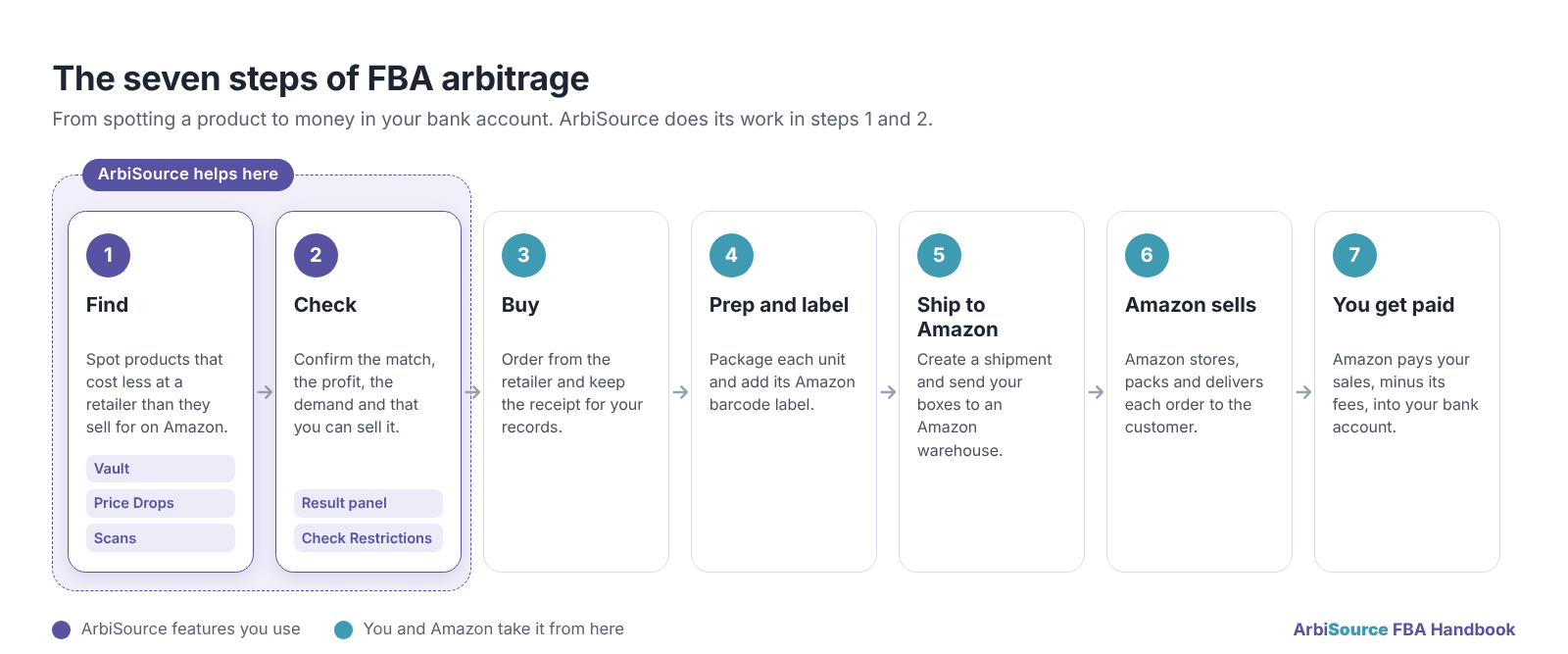
- Find a product that sells on Amazon for more than it costs at a retailer, after all fees.
- Check it with the Lead Check (Part 3).
- Buy it and keep the receipt.
- Prep and label it: every unit needs its own Amazon barcode (an FNSKU), plus any packaging Amazon requires. You can do it yourself or pay a prep center.
- Ship it to Amazon.
- Amazon sells it and takes its fees.
- You get paid on Amazon's payout cycle (payout policy).
What it costs to get started
At least a few hundred dollars for stock is a realistic minimum to start. What matters is understanding where the money goes and how long it's tied up.
Fixed monthly costs
| Cost | Notes |
|---|---|
| Amazon Professional selling plan | $39.99 a month (Amazon US pricing) |
| ArbiSource | From $54.99 a month (Essentials). See Choosing your ArbiSource plan |
| Optional tools | For example, a separate research or price-tracking subscription |
Costs per item sold
- Amazon's referral fee: a percentage of the selling price, which varies by category.
- The FBA fulfillment fee: based on the item's size and weight.
- Storage: a monthly charge for the space your stock takes up.
- Shipping your stock to Amazon.
- Prep: your own supplies, or a prep center's per-unit charge.
One-off set-up costs
- A thermal label printer and labels for FNSKU and box labels
- Polybags, boxes, tape and a set of scales
- Stock: start small and spread it across several different products
The cash cycle: money in, money out
Your money is tied up for longer than most people expect. Stock has to reach you, be prepped, travel to Amazon, sell and be paid out, so a month or more between buying and getting paid is common.
- Keep some money back. Don't put your whole budget into your first order.
- Prefer products that sell steadily over ones that might sell for a lot "eventually".
- Reinvest gradually as payouts start arriving.
More in Chapter 27.
Is it right for you? A quick self-check
You'll probably enjoy this if you like hunting for bargains, are comfortable checking details carefully, can leave a modest amount of money working for a month or two, have some space for stock (or use a prep center), and are happy to learn as you go.
It may not suit you if you need guaranteed income quickly, or if you can't afford for some of your first purchases to sell slower than you'd hoped.
You'll see a lot of big numbers online. We don't make income promises, because results depend entirely on your choices, your effort, your budget and the market. What we can do is show you a careful, repeatable method and a tool that makes it faster.