Chapter 26: VAT and your margins
General information only, not tax advice. VAT depends on your circumstances and on the products you sell, so speak to an accountant before making VAT decisions.
VAT on Amazon's fees
If your business is established in the UK, Amazon charges VAT on its fees: referral fees, fulfilment fees, storage and your monthly plan. Amazon quotes its fees excluding VAT, so the price you actually pay is higher.
- Not VAT registered: you can't reclaim that VAT, so at the UK standard rate of 20% (VAT rates on GOV.UK), Amazon's fees effectively cost you 20% more than the quoted figure.
- VAT registered: you can normally reclaim the VAT on Amazon's fees, so the fees cost you the quoted figure.
The same applies to other business costs that include VAT, such as software subscriptions and prep supplies.
The same product, two VAT positions
Here's the boxed toy from Chapter 25, selling at £24.99 and bought for £12.00 (including VAT) from a retailer. Amazon's fees are £7.10 excluding VAT, including one month's storage. Figures are rounded.
| Not VAT registered | VAT registered, with a VAT invoice for the stock | VAT registered, without a VAT invoice | |
|---|---|---|---|
| Sale price | £24.99 | £24.99 | £24.99 |
| Amazon's fees | −£7.10 | −£7.10 | −£7.10 |
| VAT on Amazon's fees | −£1.42 | None (reclaimed) | None (reclaimed) |
| Stock cost (including VAT) | −£12.00 | −£12.00 | −£12.00 |
| VAT collected on the sale (1/6 of the price) | – | £4.17 | £4.17 |
| VAT on the stock you can reclaim | – | £2.00 | None (no VAT invoice) |
| VAT due to HMRC | – | −£2.17 | −£4.17 |
| Profit | £4.47 | £3.72 | £1.72 |
In short: once you're VAT registered you pay VAT on every sale (1/6 of the price on standard-rated products), offset by the VAT you reclaim on Amazon's fees and on stock with a valid VAT invoice. So VAT invoices make a real difference: choose retailers that provide them and keep them with your order confirmations.
Some, such as books, children's clothes and most food, are zero-rated or reduced-rated, so the VAT due on the sale is lower or nil. Your accountant can tell you how this applies to what you sell.
The registration threshold
You must register for VAT when your taxable turnover goes over the registration threshold in any rolling 12-month period. Turnover means your total sales, not your profit. Because arbitrage involves buying and selling a lot of stock, turnover can grow much faster than profit.
👉 Check the current figure on GOV.UK: VAT registration.
Keep an eye on your rolling 12-month sales total, and talk to your accountant early when you're approaching the threshold (including about voluntary registration).
Income tax and Corporation Tax
Your profit is taxed too: through Self Assessment as a sole trader, or through Corporation Tax for a limited company (see Chapter 23). The amounts depend on your overall income, so we don't build them into product calculations. Your accountant handles the returns. Your job is to keep tidy records of every purchase and sale.
In ArbiSource
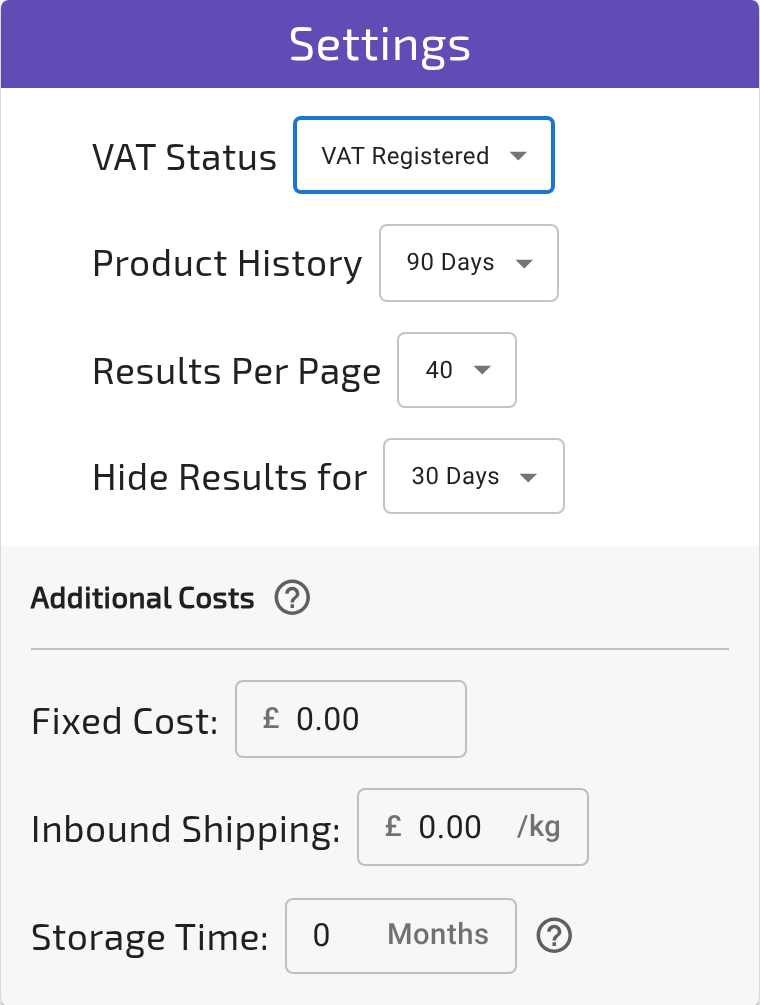
Set your VAT Status on the Settings tab of the Account page (Chapter 3):
- Not VAT Registered: ArbiSource adds the VAT on Amazon's fees to your costs.
- VAT registered: ArbiSource removes the VAT from Amazon's fees (the Fees breakdown no longer includes VAT on Fees) and adds a VAT Due figure next to Profit, ROI and Fees: the VAT collected on the sale minus the VAT on the cost of goods. The buy price is still shown including VAT. Hover over VAT Due to see the breakdown: VAT Due on Sale Price and VAT Reclaim on Purchase. This matches the middle column of the table above.
The calculation assumes the standard rate and that you can reclaim the VAT on your buy price. Without a VAT invoice (right-hand column) or on zero-rated and reduced-rate products, adjust for the difference yourself.