Chapter 28: Pricing and repricing
What you'll learn: how to set a selling price that protects your profit, how to stay in the Buy Box without racing to the bottom, and when automated pricing is worth turning on.
Start from the numbers you already trust
When you bought the product, you checked profit at the average selling price, not only at today's spike (Chapter 7 and Chapter 19). That average is still your anchor once the stock is live:
- Set a floor at or a little above the price that still meets your minimum profit and ROI after every fee.
- Set a ceiling near the recent high only if the chart shows the price has held there. Don't bank on a one-day spike.
- Watch Low-Price FBA bands. Crossing £20 (or £10 in some categories) can change the fulfilment fee (Chapter 5.1). A tiny price cut that drops you into a lower fee band can help; a rise that pushes you out can hurt.
ArbiSource still helps after you buy: keep the product on your Sourcing List with auto refresh switched on (the refresh icon), and use Alerts (from the Pro plan) if the Amazon or retailer price moves.
Competing for the Buy Box
Most sales go to the seller in the Buy Box (Chapter 10). Useful habits:
- Stay at or very near the competitive price, not far below it.
- FBA stock in New condition on a healthy account is already a strong offer.
- Don't undercut by pennies in a race. If another seller drops below your floor, let them have the Buy Box until the price recovers, or remove the listing if the product no longer works.
Amazon's Automate Pricing
Seller Central includes a free Automate Pricing tool. You set rules (match the Buy Box, stay a set amount below it, and so on) with a minimum and maximum price. The minimum is your floor; never leave it blank.
Start simple:
- One rule that matches the Buy Box, within your min and max.
- Apply it to a few SKUs you know well.
- Check the sales and the realised price after a week before you widen it.
Third-party repricers exist for larger catalogues. They're optional; many sellers do fine on Amazon's tool until they have dozens of active SKUs.
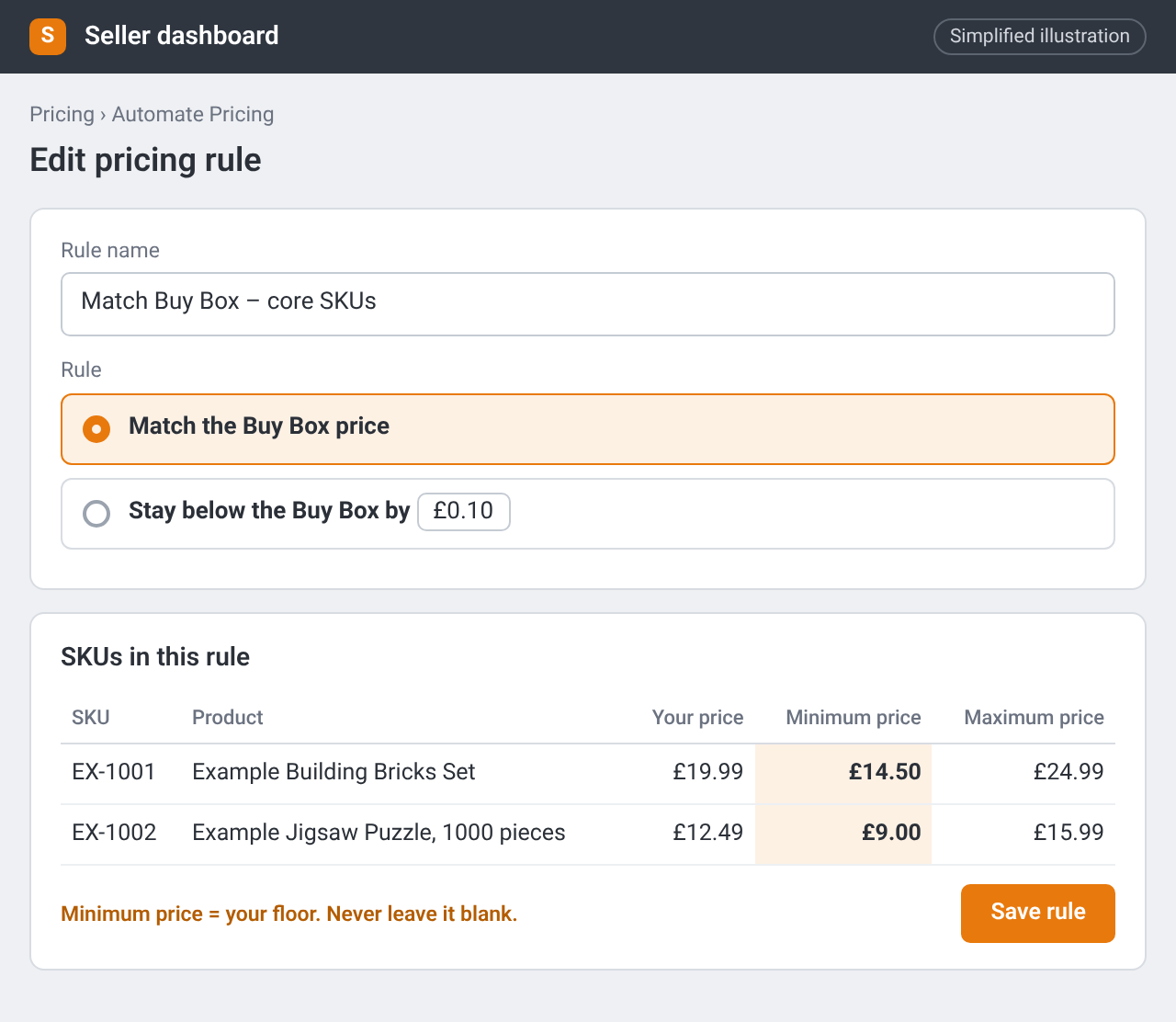
An Automate Pricing rule with a minimum and maximum price for each SKU. The minimum is your floor. Simplified illustration – the real screen may look different.
When to change your mind
- Price falling and stuck below your floor → stop replenishing; consider a removal order if aged fees are a risk (Chapter 29).
- Steady sales at your floor → keep going; add a replenishable alert (Chapter 30).
- You keep winning the Buy Box only by cutting below your floor → that lead failed the Money check in hindsight; pass next time.
Checklist
- Every live SKU has a written floor based on average-price profit
- I'm not racing below my floor to win the Buy Box
- If I use Automate Pricing, min and max are set on every rule