Chapter 1: Is FBA arbitrage right for you?
What you'll learn: what arbitrage is, the four main ways to do it, how an item travels from a shop shelf to an Amazon customer, what it costs to get going and how much time it takes. By the end you'll be able to decide, with your eyes open, whether this is for you.
What "arbitrage" means
Arbitrage means buying something where it's cheaper and selling it where it's worth more. Retailers run sales, clear old stock and price-match each other all the time. Meanwhile the same product may be selling steadily on Amazon for more. An arbitrage seller spots that gap, buys the product and resells it on Amazon at the going price.
It's a legitimate, long-established business model, and Amazon allows it. Products bought from genuine retailers are genuine products. Thousands of sellers on Amazon.co.uk run their businesses this way, from people fitting it around a full-time job to established companies with staff.
The four models
| Model | Where you buy | What it's like | In ArbiSource |
|---|---|---|---|
| Online arbitrage (OA) | Retailers' websites | Source from home at any time; stock is delivered to you | Vault, Price Drops, store and category scans, custom scans |
| Retail arbitrage (RA) | Physical shops | You see the product in person and can find in-store-only clearance | ArbiSource helps you spot which products and brands are worth looking for |
| Amazon-to-Amazon (A2A) | Amazon itself, when a listing drops well below its usual price | Buy on Amazon, then resell when the price recovers | A2A flips and Business A2A (Premium) |
| Wholesale | Brands and distributors, in bulk | Larger orders, supplier invoices and repeatable products | Wholesale scans (Pro and Premium) |
Most beginners start with online arbitrage, because it's the easiest to fit around other commitments and the easiest to learn with a tool. That's also where ArbiSource is strongest: it covers 660+ UK and US retailers, with more added regularly, plus a library of ready-made results to learn from.
How Fulfilment by Amazon (FBA) works
With FBA, Amazon stores your stock in its warehouses (called fulfilment centres), picks and packs each order, delivers it to the customer and handles customer service and returns. You pay Amazon fees for this service. In return your products become eligible for Prime delivery, which customers love.
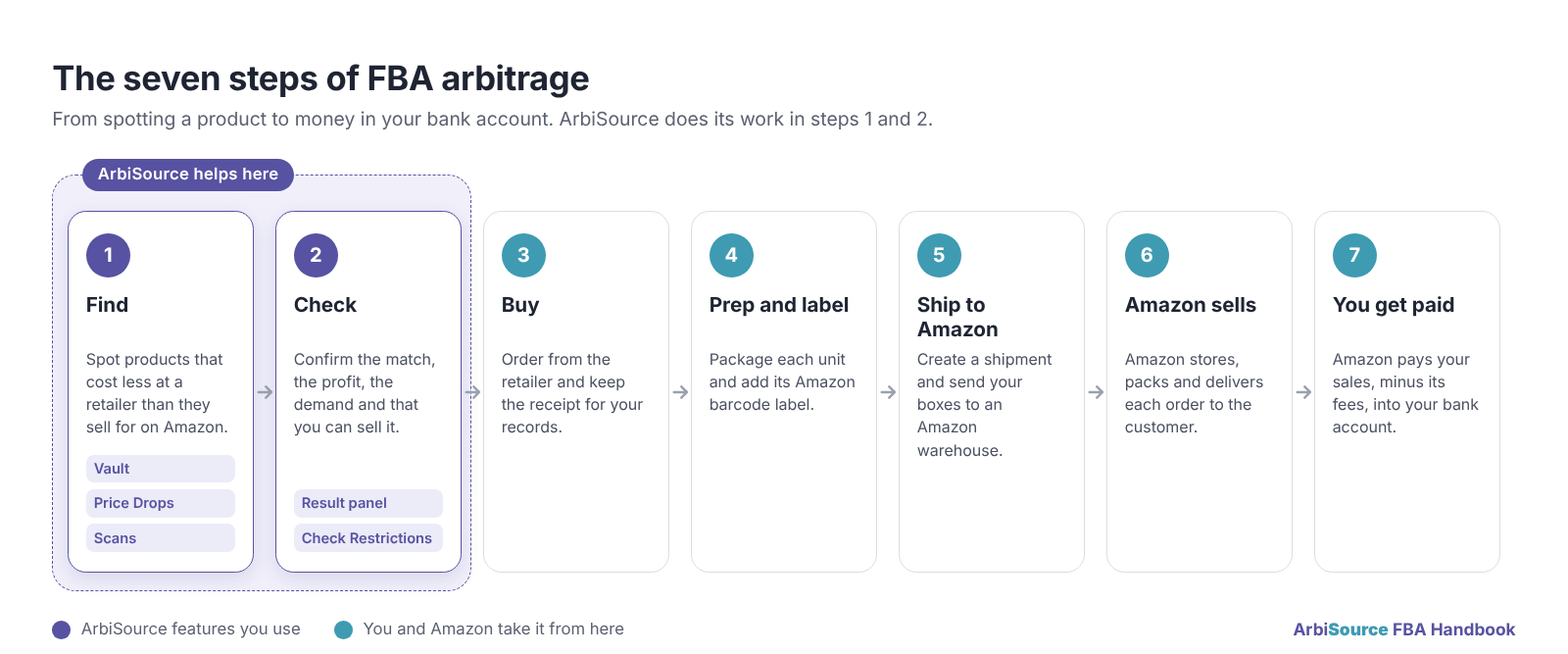
Here's the journey of a single item:
- Find a product that sells on Amazon for more than it costs at a retailer, after all fees.
- Check it carefully: is it the same product, is the profit real, does it sell steadily, and are you allowed to sell it? (That's the Lead Check in Part 5.)
- Buy it from the retailer and keep the order confirmation or receipt.
- Prep and label it. Every unit needs its own Amazon barcode label (an FNSKU) covering the manufacturer's barcode, plus any packaging Amazon requires, such as a polybag. Prep is your responsibility. You can do it at home or pay a prep centre to do it for you.
- Ship it to Amazon using a shipment you create in Seller Central.
- Amazon sells it, delivers it and takes its fees.
- You get paid. Amazon pays out on a regular cycle (settlement every 14 days, with each sale's funds released 7 days after delivery). Amazon's payout policy
What it costs to get started
There's no single right budget. People start with anything from a few hundred pounds to a few thousand. What matters more is understanding where the money goes and how long it's tied up.
Fixed monthly costs
| Cost | Notes |
|---|---|
| Amazon Professional selling plan | £25 a month excluding VAT (Amazon UK pricing) |
| ArbiSource | From £39.99 + VAT a month (Essentials). See Choosing your ArbiSource plan |
| Optional tools | For example, a Keepa subscription for detailed price history |
Costs per item sold
- Amazon's referral fee: a percentage of the selling price, which varies by category.
- The FBA fulfilment fee: based on the item's size and weight.
- Storage: a monthly charge for the space your stock takes up.
- Shipping your stock to Amazon.
- Prep: your own supplies, or a prep centre's per-unit charge.
Part 2 explains every one of these, with links to Amazon's current figures. ArbiSource works most of them out for you on every product.
One-off set-up costs
- A thermal label printer and labels for FNSKU and box labels
- Polybags, boxes, tape and a set of scales
- Stock: start small and spread it across several different products
The cash cycle: money in, money out
Your money is tied up for longer than most people expect. You pay for stock today. It then takes time to arrive with you, be prepped, travel to Amazon, be checked in, sell and be paid out. A month or so between buying and getting paid is common, and slower-selling items take longer.
So:
- Keep some money back. Don't put your whole budget into your first order.
- Prefer products that sell steadily over ones that might sell for a lot "eventually".
- Reinvest gradually as payouts start arriving.
Chapter 7 (Profit, ROI and cash flow) covers this in detail.
How much time it takes
Like any skill, sourcing is slow at first and quicker with practice. While you're learning, aim for at least an hour or two a day of browsing and checking leads, plus a longer session once a week to prep and ship. Checking a lead properly takes a while at first; with practice you'll get faster, and many sellers then fit their sourcing around a job. ArbiSource does the scanning and maths so your time goes on decisions rather than spreadsheets.
Is it right for you? A quick self-check
You'll probably enjoy this if you:
- like looking for bargains and spotting patterns
- are comfortable checking details carefully (the right pack size, the right colour)
- can put aside a modest amount of money and leave it working for a month or two
- have a little space at home for stock and packing, or are happy to use a prep centre
- are happy to learn as you go and treat early purchases as practice
It may not suit you if you need guaranteed income quickly, or if you can't afford for some of your first purchases to sell slower than you'd hoped.
You'll see a lot of big numbers online. We don't make income promises, because results depend entirely on your choices, your effort, your budget and the market. What we can do is show you a careful, repeatable method and a tool that makes it faster.
Checklist
- I understand the difference between OA, RA, A2A and wholesale
- I know the seven steps from finding a product to getting paid
- I've set a starting budget, with some held back
- I've blocked out an hour or two a day for sourcing while I learn, plus a weekly prep and ship session